
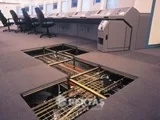
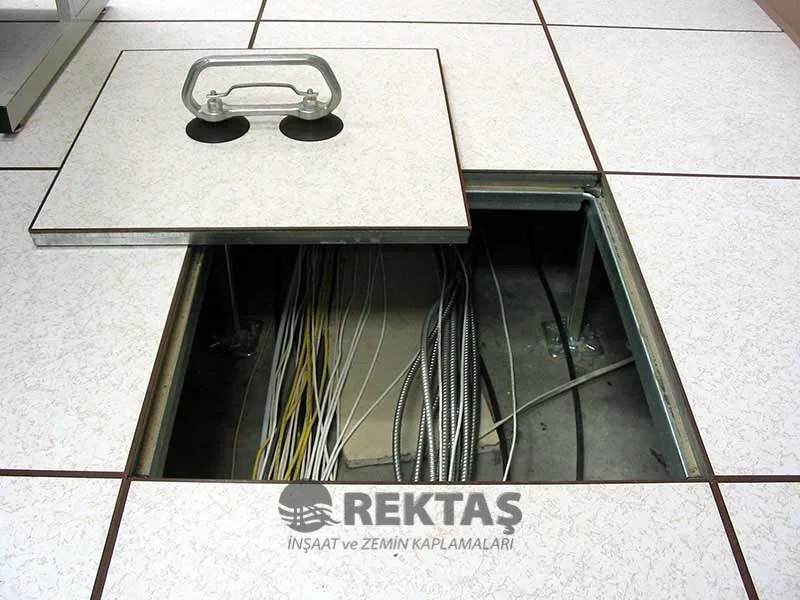
What is Raised Floor (Access Floor)?
Raised floor systems are modular, flexible and high-tech floor covering solutions used in a wide range from data centers to offices, command control rooms to clean rooms today. These systems, ideal for cabling, ventilation and infrastructure management, stand out with superior features that respond to the complex technical needs of modern structures.
Raised Floor Panel Structure and Types
Raised floor panels can consist of different materials and structures:Steel Encapsulated Panels:
Most commonly used panel type. Core material (wood chipboard, cement-based or calcium sulfate) is coated with steel sheet. Top and bottom surface is 0.7-1.5 mm thick galvanized steel sheet. Economical and durable. Load capacity is medium-high level.
Aluminum Panels:
Lightweight and high strength panels. Produced in aluminum honeycomb core or aluminum composite structure. Corrosion resistance is excellent. Ideal for clean rooms and special applications. Cost is high.
Calcium Sulfate Panels:
High density calcium sulfate core, steel coated panels. Fire resistance is very high (Class A1). Moisture resistance is good. Preferred in heavy load capacity applications. Ideal for data centers.
Wood Core Panels:
Wood chip or plywood core, steel coated economical panels. Lightweight and easy to process. Used only in dry indoor areas due to moisture sensitivity. Suitable for office applications.
Cement-Based Panels:
High density cement composite core panels. Fire and moisture resistance is good. Preferred in mid-segment applications. Dimensional stability is high.
Glass Panels:
Transparent or translucent tempered glass panels. Used in decorative purpose, special design projects. Provides visual effect with underlighting. Load capacity is low, applied only in light traffic areas.
Antistatic Panels:
Panels produced with conductive or dissipative properties, providing static electricity control. Critical for electronic production, data centers, operating rooms. Meets ESD standards.
Advantages of Raised Floor Systems
Flexible Cabling and Infrastructure Management The most important advantage of raised floor is easy placement and management of electrical, data, telephone, fiber optic and all other cable systems in the subfloor space. Cables are invisible in ceiling or walls. Infrastructure is easily accessed by removing panels during station changes, new equipment addition or office layout changes. Changes can be made with minimum interruption. Cable clutter and visual pollution are eliminated. Maintenance and update costs are low.HVAC and Climate Control Efficiency Subfloor space can be used as ventilation distribution channel. In Underfloor Air Distribution (UFAD) systems, cold air comes from subfloor and rises upward. This system is 20-30% more energy efficient than traditional ceiling distribution systems. User-based heat control is provided with individual air outlets. Layered heat distribution occurs (cool at bottom, warm at top). Indoor air quality increases. Noise level decreases.
Easy Access and Maintenance Panels can be easily removed by hand or suction devices. Instant access to infrastructure equipment. Maintenance, repair and update operations are fast. Creates minimum interruption in workflow. Provides quick solution in situations requiring emergency intervention (water leakage, cable failure). Reduces long-term maintenance cost.
Aesthetic and Clean Appearance All cables, installations and technical equipment are hidden. Ceiling and walls do not require cable channels, cable routes. Modern, minimalist and professional appearance is provided. Provides visual order and cleanliness in open plan offices. Cable clutter and visual pollution are eliminated.
Weather Resistance Quality systems can carry 500-1500 kg/m² point load and 1000-5000 kg/m² distributed load. Heavy server racks, UPS systems, air conditioning units can be safely placed. Critical feature for data centers and technical rooms. System stability is high, no risk of shaking or collapse.
Fire Safety and Smoke Control Calcium sulfate panels are Class A1 non-combustible material. Subfloor is ideal for fire detection and extinguishing systems. Gas extinguishing systems like FM-200, Inergen can be distributed from subfloor. Smoke exhaust systems can be integrated. In case of fire, subfloor controls smoke spread. Provides security for data centers and critical facilities.
Acoustic Comfort Floor system provides sound insulation. Footstep sounds and inter-floor noise decrease. Subfloor shows sound absorption feature. Isolates HVAC system noise. Acoustic comfort increases in open plan offices. Performance can be increased with special acoustic filling materials.
Flexibility and Adaptation Floor configuration can be easily changed during office layout changes. Integration of new technologies is easy. Adapts to future needs. Long-term value of investment is high. Modular structure allows expansion and changes.
Static Electricity Control Antistatic systems protect sensitive electronic equipment. Prevents ESD damages. Reduces data loss and equipment failure risk. Critical in electronic production and data centers. Increases work safety.
Health and Hygiene Non-porous surface coatings prevent bacteria and germ growth. Cleaning is easy and effective. Dust and allergens do not accumulate. Provides hygienic environment in hospitals and clean rooms. Supports indoor air quality.
Raised Floor Structural Features
Basic Components
- Adjustable Pedestals: Vertical support elements carrying raised floor from main floor. Produced from steel or aluminum material. Consists of three parts: base plate, adjustable body, head plate. Height adjustment can be made from 5 cm to 150 cm with screw mechanism. Standard heights are between 15-60 cm. Each pedestal has 500-2000 kg load carrying capacity.
- Head Plate: Metal plate located on top of pedestal, carrying panels. Usually 100x100 mm or 150x150 mm sizes. Section where panel corners sit and are fixed. Contains locking mechanism in some systems.
- Stringers: Metal profiles or channels providing connection between pedestals, supporting panels from edges. Applied as cross or grid system. Increases system stability and optimizes load distribution. Optional component, not used in some systems (stringerless system).
- Floor Panels: Modular square panels forming upper walking surface. Standard sizes 600x600 mm or 610x610 mm. Thickness varies between 28-60 mm. Produced in various materials and load capacities. Can be easily removed and reinstalled.
- Ramps and Steps: Access elements eliminating level difference between raised floor and main floor. Ramp slope should be between 8-12%. Important for disabled access.
- Edge Trims: Finishing profiles closing perimeter edges of raised floor, providing aesthetics and safety. Produced from aluminum or PVC material.
- Air Outlet Plenums: Special panels with perforated or grated surface providing air flow from bottom to top. Used in HVAC systems. May contain adjustable air flow mechanism.
Application Areas of Raised Floor Systems
Data Centers and Server Rooms
- Tier I-IV data centers
- Colocation facilities
- Cloud server rooms
- Telecommunication central switchrooms
- Internet exchange points
- Backup and disaster recovery centers
- Blockchain mining facilities
- Supercomputer installation areas
Features: Heavy load capacity, antistatic, high plenum (40-60 cm), calcium sulfate panels, strong HVAC integration.
Command and Control Centers
- Traffic control centers
- Power plant control rooms
- Airport tower and control centers
- Security and surveillance centers (SOC)
- 112 Emergency call centers
- Military command centers
- Smart city management centers
- Logistics tracking and coordination centers
Features: 24/7 usage, ergonomic design, easy cable access, antistatic feature for image quality.
Educational Institutions
- University computer laboratories
- Libraries and study areas
- Distance education studios
- Simulation and research laboratories
- Conference and seminar halls
- E-exam centers
- Digital archive rooms
Aviation and Defense
- Air traffic control towers
- Aircraft hangar technical offices
- Defense industry production facilities
- Military communication centers
- Radome and radar facilities
- Flight simulator rooms
- Air force command centers
Features: High security, antistatic, electromagnetic interference protection.
Raised Floor Installation Process
1. Project Planning and Design
Successful raised floor project requires detailed planning. In first stage, usage purpose, load requirements, height need, infrastructure needs (electrical, data, HVAC) are analyzed. Technical drawings and layout plans are prepared. Panel grid system is determined (600x600 mm or 610x610 mm). Pedestal positions are marked. Ventilation panel positions are planned. Ramp and access points are designed.
Structural analysis is done. Main floor load carrying capacity is checked. Compatibility with building structural system is ensured. Seismic requirements are evaluated. Fire safety planning is done. Electrical grounding (in antistatic systems) is designed.
2. Floor Preparation and Inspection
Main floor should be clean, dry and flat. Concrete floor should be at least 28 days cured. Surface flatness is critical: maximum 3 mm difference in 3 meter measurement. Uneven floor makes pedestal height adjustments difficult and increases cost. Floor moisture ratio should be below 75% RH. High moisture may cause corrosion in metallic components. Floor strength is tested, minimum 25 MPa compression strength required. Cracks are repaired with epoxy injection. Oil and dirt residues are cleaned. Floor slope and drainage are checked.
3. Floor Marking and Grid Determination
Floor highest point is detected with laser level. This point is taken as reference. Lines are drawn or marked with laser for grid system. First pedestal position usually starts from room corner or center. All pedestal positions are marked (typically 675 mm intervals for 600x600 mm grid). 150-300 mm distance is usually left to wall edges. Column and fixed equipment positions are carefully planned. Ventilation panel and special detail points are marked.
4. Base Plates and Pedestal Installation
Base plates are placed on marked positions. Fixed to floor with adhesive or mechanical anchor. Fixing method is selected according to load and seismic requirements. Adhesive tape or epoxy is used in light applications. Mechanical anchor (Dowel, Chemical Anchor) is mandatory in heavy load and data center applications.
Pedestals are mounted on base plates. Initial height is approximately adjusted. First row pedestals are precisely adjusted with laser level. This row forms foundation of entire system, carries critical importance. Precision should be ±1 mm. Pedestal heights are adjusted with screw mechanism. Each pedestal head should be at same level. Digital level meter or laser level system is used. Tolerance is ±0.5 mm. ±0.25 mm tolerance is applied in high precision applications (data centers).
5. Stringer Installation
In stringer system applications, metal beams are mounted between pedestals. Grid system (square or cross) is formed. Stringers are fixed to pedestal heads with screws or clips. System rigidity and stability are increased. Load distribution is optimized.
Stringers can also be used as electrical and grounding path. In antistatic systems, grounding cables are connected via stringers. Electrical connection is provided at stringer intersection points. This step is skipped in stringerless systems. Panel directly sits on pedestal heads. Installation speed increases, cost decreases.
6. Panel Laying
Panels are placed according to grid system. Each panel sits on four pedestal heads. 1-2 mm gap is left at panel corners (expansion allowance). Panels are carried and placed by hand or special suction devices.
First panel placement is critical. Correct position and level are checked. Subsequent panels are laid in order. Level check is done after each panel placement. Pedestal heights are corrected if there is shaking or distortion.
Cutting may be required for edge panels. Circular saw or jigsaw is used for steel coated panels. Cutting precision is important. Closed with edge finishing profiles.
Ventilation panels (perforated/grated) are placed in planned positions. Air flow direction is checked. Cable access panels (grommet) are laid at high cable density points.
7. Level Control and Correction
Comprehensive level check is done after all panels are laid. Each panel is checked with laser level or precise digital level meter. Level deviations are detected. Pedestal heights are corrected when necessary. Surface is checked 2-3 hours after application completion (while in gel state). Roughness is corrected with metal trowel. Edges and corners are made smooth. Excess granules are removed.
Inter-panel gaps are checked. 1-2 mm gap ideal, more than 3 mm not accepted. Wide gaps may require panel replacement. Panel corner alignments are checked, if warping exists, panel or pedestal is changed. Walking test is done. Shaking, squeaking, impact sounds are checked. Problematic areas are detected and corrected. Final level control report is prepared.
8. Surface Coating Application
Optional coating is applied on panel upper surface. Options:
Carpet Coating: Most common choice. Modular carpet tiles (500x500 mm or 600x600 mm) or roll carpet can be applied. Adhesive tape or adhesive installation. Provides acoustic comfort and aesthetics. Wide color and pattern variety. Antistatic carpet options available.
Vinyl/LVT Coating: Water resistant, hygienic and easy cleaning option. Ideal for hospitals, laboratories, clean rooms. Antistatic vinyl available. Can be applied with adhesive or click system. Wide color and pattern variety.
HPL (High Pressure Laminate): High durable, scratch resistant coating. Antistatic property can be provided. Wood, stone or solid color options available. Preferred in data centers and heavy usage areas.
Epoxy/Polyurethane Coating: Provides seamless, hygienic surface. Chemical resistant. Used in clean rooms and special applications. Antistatic formulations available.
Linoleum: Natural, ecological coating option. Antibacterial property. Preferred in healthcare facilities.
Bare Panel: No coating applied in some technical rooms. Panel's original steel surface is used. Economical but not aesthetic.
9. Ramp and Access Elements
Ramp or steps are applied between raised floor and main floor. Ramp slope should be between 8-12%. Maximum 8% slope recommended for disabled access. Ramp length is calculated according to height.
Ramp structure consists of aluminum or steel profiles. Upper surface is coated with non-slip material. Safety railings are added when necessary. Steps can also be used as alternative, standard 17 cm height and 30 cm depth applied.
10. Edge Profiles and Finishing
Floor edges are closed with aluminum or PVC profiles. Profiles provide aesthetic transition at points adjacent to walls and fixed equipment. Closes sharp edges for safety. Eliminates tripping and injury risk.
Fixed with screws or adhesive. Color option available, usually color compatible with coating is selected.
10. Edge Profiles and Finishing
Floor edges are closed with aluminum or PVC profiles. Profiles provide aesthetic transition at points adjacent to walls and fixed equipment. Closes sharp edges for safety. Eliminates tripping and injury risk.
Fixed with screws or adhesive. Color option available, usually color compatible with coating is selected.
11. Grounding and Antistatic Test (When Required)
Electrical continuity is tested in antistatic systems. Each panel and pedestal is connected to grounding system. Grounding point is connected to main grounding bar. Surface resistance is measured with test device (according to IEC 61340-4-1 standard).
Target values:
- Conductive: 10^4 - 10^6 ohm
- Dissipative: 10^6 - 10^9 ohm
- Insulative: >10^11 ohm
12. Infrastructure Laying and Organization
Infrastructure works are done by removing panels. Electrical cables, data cables, fiber optic, telecommunication cables are laid. Cable baskets, cable channels or free laying method is used for cable management.
HVAC systems are integrated. Air ducts, cooling pipes, valves and control systems are placed. Air flow tests are done. Leakage is checked. Fire detection and extinguishing systems are installed. Smoke detectors, gas extinguishing nozzles, pressure sensors are mounted. System tests are done. All infrastructure components are labeled. Documentation is prepared. As-built drawings are updated.
13. Acceptance Tests and Delivery
All tests are reported. Defects are corrected. Project is completed and delivered.
Maintenance and Cleaning
Although raised floor systems require low maintenance, regular control is important for long life and performance:
-
Daily Maintenance:
Surface sweeping or vacuum cleaner cleaning
Routine cleaning according to coating type (carpet, vinyl)
Immediate cleaning of stains and spills -
Monthly Cleaning:
Deep cleaning of surface coating
Checking inter-panel gaps
Cleaning ventilation grilles -
Annual Deep Cleaning:
Random panel removal and subfloor cleaning
Checking pedestals and connection points
Grounding continuity test (in antistatic systems)
Level control (with laser level)
Load carrying capacity assessment - In case of water leakage, panels are immediately removed, area dried
- In case of fire, gas extinguishing protocol is applied
- In case of structural damage, area is closed, professional assessment is done
- In case of equipment failure, quick access is provided
What Not to Use:
Excessive water or chemical use (damages metallic parts)
Placing heavy equipment at panel transition points
Exceeding point load limit
Storing flammable materials in subfloor
Closing or blocking ventilation panels
Emergency Procedures:
Raised Floor Prices
Panel type and material (steel, aluminum, calcium sulfate)
- Load capacity (light, medium, heavy load)
- Panel size (600x600 mm, 610x610 mm or special)
- Total height (low, standard, high plenum)
- Stringer system (with stringer, stringerless)
- Antistatic property (standard, ESD)
- Surface coating (carpet, vinyl, HPL, epoxy)
- Area size (m² price decreases in large areas)
- Floor condition and preparation requirement
Contact us for current prices or visit our online store.
Comparison of Raised Floor with Other Floor Coverings
Raised Floor vs Standard Concrete Floor
Standard concrete floor is economical and simple but infrastructure management is difficult. Cables go in ceiling or wall, maintenance and change costs are high. Raised floor has high initial investment cost but provides flexibility and maintenance ease in long term. HVAC integration is not possible in standard floor. Raised floor is indispensable for data centers and modern offices.
Raised Floor vs Suspended Ceiling Under Cabling
Suspended ceiling under cabling is traditional method. Cost is low, application is simple. But cable organization is difficult, looks complex, access is difficult (ladder required). Raised floor provides clean appearance, easy access and superior organization. Much more flexible in office layout changes. HVAC integration is only possible with raised floor.
Raised Floor vs Cable Trunking
Cable trunking is economical and simple solution. Sufficient for small offices. But flexibility is limited, creates aesthetic problems, capacity is limited. Inadequate in large and complex areas. Raised floor provides unlimited capacity, full flexibility and professional appearance.
Raised Floor vs Underfloor Ducts
Underfloor ducts are fixed channels embedded in concrete. Permanent, cannot be changed. Initial planning is critical, mistakes are expensive. Raised floor is completely flexible and changeable. Adaptation to future needs is excellent. Cost is similar but raised floor is advantageous in long term.
🔗 Our Other Floor Services
Let's work together
We are the architects of innovation, the pioneers of development. As a strong business partner accompanying you in your success, we aim to add value in every project.